

If you've ever put a gold coin frog by your front door or hung a red tassel for luck, you've practised symbolic Feng Shui. There's nothing wrong with that. But it's not the same thing as what I do, and the two get confused all the time.
Let me explain the difference, and why it matters.
Two Very Different Origins
Symbolic Feng Shui, sometimes called Popular Feng Shui, grew out of a genuine need. For most of history, the deep formulas of classical Feng Shui were reserved for emperors and the elite. They weren't shared. So symbolic Feng Shui became a way to bring the spirit of good energy to everyday people, using objects, colours, and imagery. A gold coin trinket to represent wealth. A pair of mandarin ducks for love. It's accessible, it's visual, and it works through manifestation and intention. For a lot of people, it's their first meaningful step into thinking about how their home affects their life. That has real value.
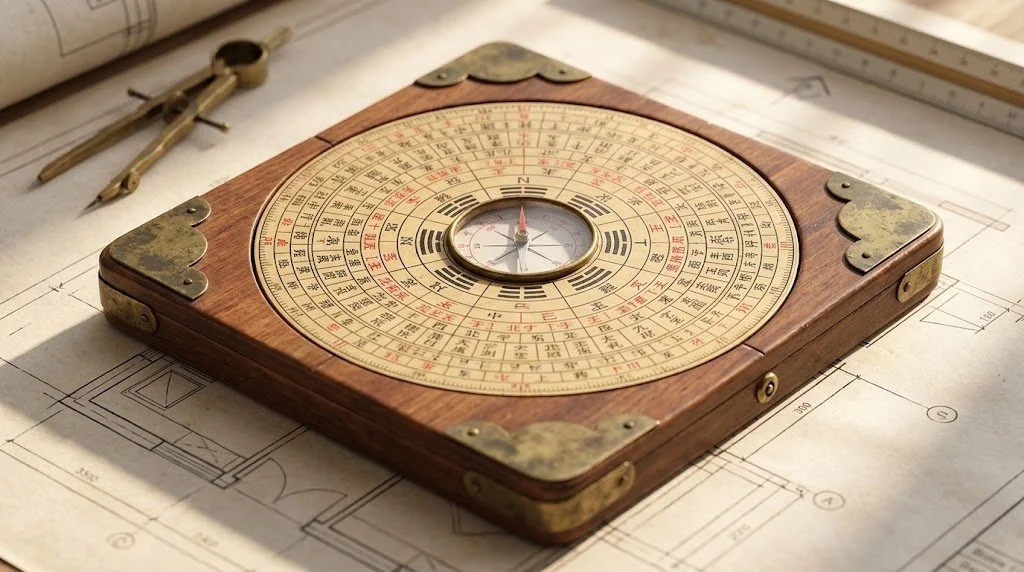
Classical Feng Shui is a different discipline entirely. It's a formula-based system, built on precise calculations using compass direction, time, and the structure of a building. Its roots go back thousands of years, and the formulas I use in my own practice trace back to the Tang Dynasty. This isn't decoration. It's mathematics, astronomy, and observation, refined over centuries and originally reserved for imperial use.
Why the Distinction Matters
Here's the thing. A trinket can lift your mood and shift your intention. It can't change the way energy actually moves through your floorplan, the direction your front door faces, or the timing of the energy affecting your building this year. That takes calculation, not decoration.
This is why, when I walk into a client's home, I'm not looking for what to add to a shelf. I'm mapping the energy of the structure itself, using formulas that have been tested and refined since the Tang Dynasty. It's the difference between rearranging the furniture and understanding the architecture.
What Classical Formulas Actually Look At
When I talk about "formulas," I mean specific, repeatable calculations, not a feeling or a general impression of a room. My practice draws on San Yuen, San He, Flying Stars, Eight Mansions, and BaZi, each looking at a different layer of the equation:
Compass direction, taken precisely at the property, not estimated by eye
The construction period of the building, which affects how energy behaves within it over time
Time cycles, since the energy of a home shifts year to year, not just once when it's built
The occupants' birth dates calculated through BaZi, since the same home can affect different people differently depending on who's living in it
That last point matters more than people expect. Classical Feng Shui isn't only about the building. It considers time, place, and person together, because getting the most out of a space means understanding both the structure itself and who's actually living in it.
This is also where the Tang Dynasty lineage becomes more than a nice historical detail. These formulas were developed, tested, and passed down within a closed imperial tradition for centuries before they became more widely accessible. I'm the fortieth generation of that lineage, trained directly through master-to-student pass down, not from a book or a course. I've travelled to China and worked directly with the masters carrying this tradition forward. That length of refinement, and that direct line back to its source, is part of why these formulas are precise enough to work with the structure of a specific building, not just the general concept of a home.
An Everyday Way to Picture It
Imagine two people trying to navigate a city they've never been to. One has a lucky compass keychain someone gave them, a nice object, a nice thought, but it doesn't actually point anywhere useful. The other has an accurate map, drawn from centuries of surveying that specific terrain.
Both people might feel a bit more confident setting out. Only one of them is actually going to arrive where they meant to go.
That's the gap between symbolic and classical Feng Shui. One offers comfort and intention. The other offers a precise reading of the space you're actually standing in.
Both Have a Place
I want to be clear: I'm not here to put down symbolic Feng Shui. It's brought millions of people into this practice, and it has genuine psychological power. Visualisation and intention are real tools.
But if you're making decisions about a major renovation, a new build, or the direction your life is heading, you deserve the real formulas, not just the symbols. That's the level I work at, and it's why my clients come to me for the structural, calculated approach, not just the decorative one.
The Bottom Line
Symbolic Feng Shui asks you to believe.
Classical Feng Shui asks you to calculate.
Both can move you forward.
Only one of them was once reserved for emperors.
If you're weighing up a renovation, a new build, or a big life decision and you want more than a trinket's worth of guidance, that's exactly the work I do.
Kelly x