

How to Feng Shui your Living Room
When it comes to your living room, most people focus on how it looks. The sofa, the coffee table, the artwork, the styling, it all matters. And trust me, I love a beautifully curated space as much as anyone. But there is something far more important happening in your living room that you can’t see.
Energy.
In Feng Shui, your living room is one of the most influential spaces in your home. It’s where life unfolds. It’s where conversations happen, decisions are made, opportunities arrive, and relationships are either supported… or slowly chipped away at. So if your home feels slightly “off,” if you can’t fully relax, or if things just aren’t flowing the way they should, your living room is often where the story begins.
The Space Where Life Meets You
Your living room is not just a place to sit, it’s a place where energy gathers. It represents how the outside world connects with your inner world. How opportunities enter your life. How supported you feel within your own home. When this space is working well, everything feels easy. You want to be there. Conversations flow. There’s a sense of calm without even trying. When it’s not, you feel it immediately. People don’t linger. The room feels flat, or strangely uncomfortable. You might find yourself gravitating to other parts of the house without really knowing why.
That’s not a coincidence. That’s energy.
Why Your Sofa Position Matters More Than Your Sofa Itself
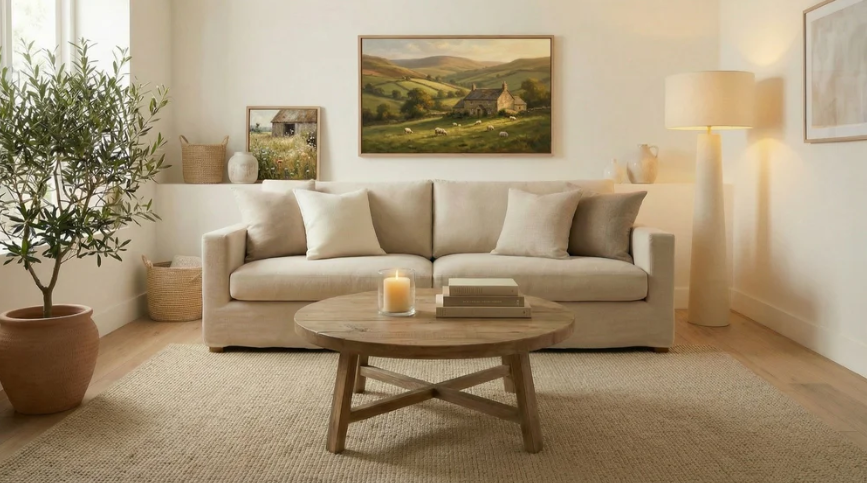
I always say this to clients, it doesn’t matter how expensive your sofa is if it’s in the wrong position. Where you sit in your living room determines how supported you feel in your life. Ideally, your main seating should have a solid wall behind it. This creates what we call energetic support, something backing you, holding you, allowing you to fully relax.
If your sofa is floating in the middle of the room or sitting with its back to the entrance, it can create a subtle sense of unease. You might not consciously notice it, but your body does. It’s that feeling of never quite being able to switch off.
And over time, that matters.
The Flow of the Room (and Why It Affects Opportunity)
One of the first things I do when I walk into a home is pause and observe how the energy moves. Does it settle? Or does it rush straight through?
If your living room sits on a direct line between a front door and a large window or opening, energy can move too quickly. And when that happens, opportunities tend to do the same. They arrive… and then disappear just as quickly. What we want is a sense of pause. A space that gently holds energy rather than pushing it away. This doesn’t require a full redesign. Often it’s about layering, bringing in a rug to anchor the space, adjusting furniture so it feels more intentional, adding texture so the room has depth.
It’s less about perfection and more about creating a space that feels like it wants to keep you there.
What Your Living Room Is Saying About Your Mind
Your environment always reflects what’s going on internally.
A cluttered living room, especially the coffee table, corners, or surfaces that collect “bits and pieces” creates a kind of background noise. It’s subtle, but it builds. And that noise shows up as mental overwhelm, lack of clarity, or that feeling of constantly having too much on your plate.
When the space is clear and considered, your mind follows. Decisions feel easier. Conversations feel lighter. There’s room to think. It’s one of the simplest shifts you can make, and one of the most powerful.
The Energy of Colour and Materials
There’s a reason certain living rooms feel instantly calming, while others feel slightly on edge.
It often comes down to balance.
Too many dark tones can make a space feel heavy and stagnant. Too many bright or sharp colours can feel overstimulating, even if they look good in photos.
What works beautifully in a living room is layering, soft neutrals, natural textures, materials that feel grounded and real. It creates a space that supports you rather than competing with you. And that’s exactly what we want.
Artwork Isn’t Just Decorative
What you hang on your walls matters more than most people realise. Your artwork sets the emotional tone of the room. It quietly influences how the space feels, even if you’re not consciously aware of it.
Pieces that feel warm, connected, or expansive tend to work beautifully in living rooms. They invite people in. They create a sense of ease. On the other hand, artwork that feels isolating, aggressive, or emotionally flat can subtly shift the energy in the opposite direction.
It’s not about following rules, it’s about being honest about how something actually feels when you look at it.
Lighting Changes Everything
Lighting is one of the most underestimated elements in a living room.
Relying solely on overhead lighting creates a flat, almost clinical feeling. It doesn’t invite people to relax or connect. When you layer your lighting—adding lamps, soft pools of light, warmer tones, the entire room changes. It becomes softer, more dimensional, more human.
And suddenly, people want to stay.
Why This Room Affects Your Relationships More Than You Think
Interestingly, I often see more relationship dynamics play out in living rooms than bedrooms.
This is where the family comes together at the end of the day. Where conversations unfold. Where energy either feels connected… or disconnected. If seating feels awkward, if people are angled away from each other, or if the space feels too sharp or cold, it impacts how people interact.
Small shifts: bringing seating closer, softening the space, making it feel more cohesive can have a noticeable effect on how people communicate.
There Is No “Perfect” Living Room
Just like kitchens, there is no one-size-fits-all solution. The most supportive living room is one that aligns with the specific energy of your home and the people living in it. Orientation, layout, timing, even personal energy all play a role.
Which is why two homes with identical furniture can feel completely different.
Real Feng Shui is never generic. It’s precise, considered, and deeply personal.
A Living Room That Supports Your Life
When your living room is working properly, you don’t have to think about it.
You feel it.
You sit down and instantly relax. Conversations flow without effort. There’s a sense of ease that’s hard to explain but impossible to ignore. And more often than not, life outside the home starts to feel easier too. Because when your environment supports you, everything else has a chance to as well.
Frequently Asked Questions About Living Room Feng Shui
Can my living room really affect my success?
Yes. It governs how opportunities enter and settle in your life. Poor flow can mean missed or short-lived opportunities.
What if my sofa can’t go against a wall?
You can create “support” with a console table behind it. It’s about creating a sense of backing.
Is minimalism better for Feng Shui?
Not necessarily. It’s about balance. Too empty can feel cold, too full can feel overwhelming.
What’s the quickest fix for a living room that feels off?
Adjust your seating so it feels more supported and connected, then soften the space with lighting and texture.
Stop fighting against your space and start making it work FOR you.
Kelly x